
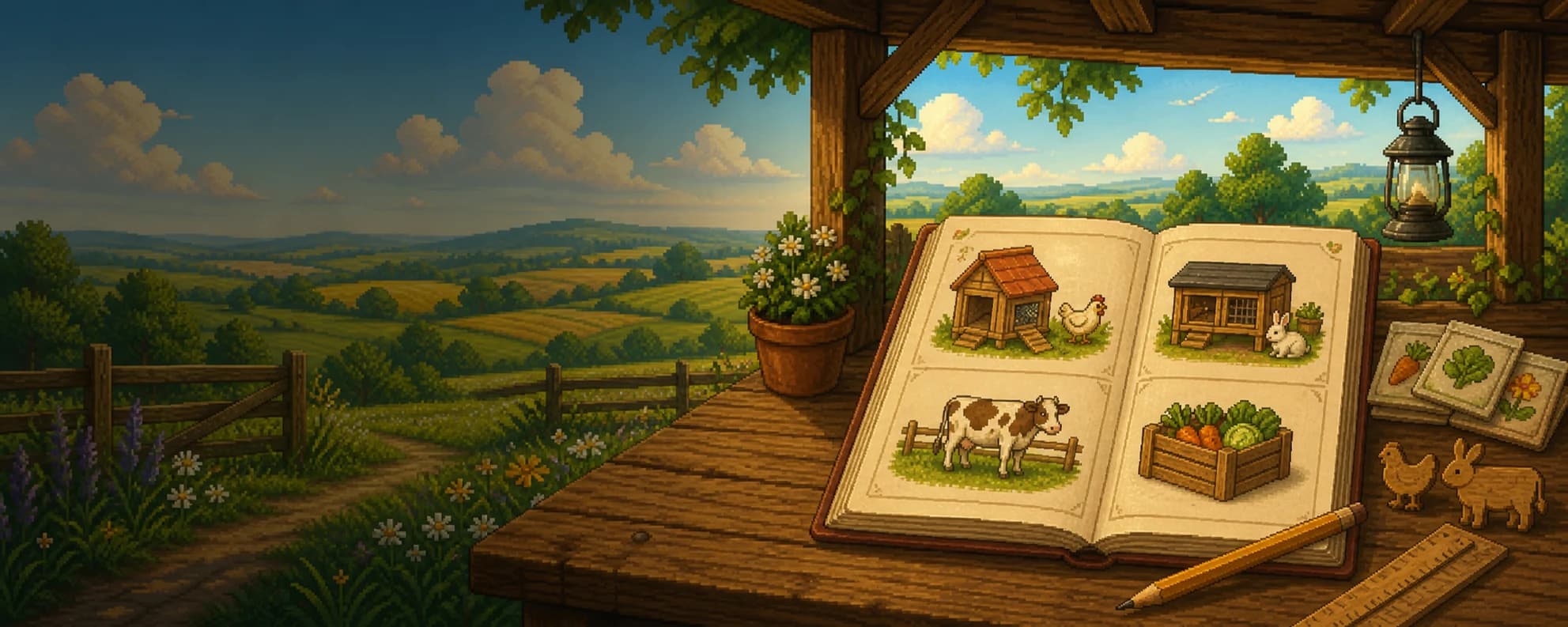
Livestock

Managing buildings
A care action serves every animal in the building that needs it, as far as your stock allows.
The well pumps 10 L of water using 1 L of fuel from the tank. Rations and care are rounded up to the litre or item on each action.
Daily care
- Food and water must be given again every day. Unfed poultry and rabbits may die during the night.
- A dirty animal that is not washed falls sick the next day. A sick animal dies after 4 days without treatment.
- Each morning, about 1 animal in 60 falls sick and 1 in 30 gets dirty.
- Lack of water reduces production and growth, but animals do not die of thirst. Each livestock's own rules are detailed below.
Births, growth and production can be slightly below forecast. This gap grows with the number of animals and shrinks when care is complete.
Henhouse
Three buildings: the poultry yard for hens and roosters, the brooding house for brooding hens, the nursery for chicks.
Rations and care
- A litre of corn feeds 3 birds; a litre of water waters 3, chicks included.
- A shampoo washes 10 birds; a treatment heals 10.

Extending buildings
- Nursery: 50 places for , or a place.
- Poultry yard: 50 places for , or a place.
- Brooding house: 50 places for , or a place.

Laying and brooding
- Each fed, watered and healthy hen lays one egg at the day change, with 1 rooster per 5 hens. Eggs neither sold nor set to brood before the next day change are lost.
- Each egg set to brood takes a hen to the brooding house for 2 days; her place in the poultry yard stays reserved. Free places in the brooding house limit the brood.
- Feed and water the brooding house too: its care decides how many eggs hatch. About one hatched egg in 20 gives twins. Chicks' sex is known from hatching.
Chick growth
- Watered chicks grow by one day; after 4 days, they move to the poultry yard.
- Chicks with no place in the nursery at hatching are lost. So are those that become adults with no place in the poultry yard.
The Cooperative buys
- Egg: .
- Male or female chick: . The youngest are sold first.
- Hen: ; rooster: .
Rabbit hutch
Two buildings: rabbits, which breed, and bunnies, which grow in three stages.
Rations and care
- A litre of wheat feeds 10 rabbits; a litre of water waters 10, bunnies included.
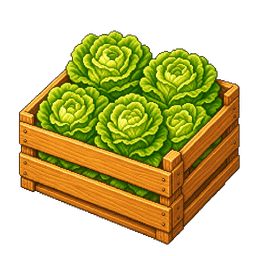
- A crate of carrots or a crate of lettuces tops up the ration of 10 adults already fed.
- A shampoo washes 30 rabbits; a treatment heals 30.
Extending buildings
- Bunnies: 50 places for , or a place.
- Adult rabbits: 50 places for , or a place.
Each pair can have one bunny a day. The breeding rate adds up the care the adults received:
- Wheat: up to 40%.
- Water: up to 10%.
- Carrots: up to 25%; lettuces: up to 25%.
Each contribution depends on the share of adults served. Dirty or sick adults reduce births further.
Births beyond the bunnies' free places are lost.
Growth
- Fed and watered, bunnies move up a stage each day: baby, small, big, then adult. Their sex shows at adulthood.
- A bunny that becomes an adult with no free place among the rabbits is lost.
The Cooperative buys
- Bunny: . The youngest are sold first.
- Adult buck or doe: .
Pastures
The Pastures hold cows, bulls and calves, with no space limit.
Rations and care
- A bale of straw feeds 2 cattle; a litre of water waters 2, calves included.
- A shampoo washes 2 cattle; a treatment heals 2.

Breeding and growth
- Each cow spends 3 days in heat, then 10 days resting. Mated while in heat, she stays pregnant for 6 days, gives birth to a calf, then rests.
- Mating costs per cow and needs a free bull. The result comes the next day and depends on the herd's food, water and health. The bull rests for 6 days, even if mating fails.
- Fed and watered calves become adults in 6 days. Their sex shows then.
Milk
- Each resting cow gives about 16 L of milk a day if the herd is fed, watered and healthy. Milk is added to your stock at the day change.
- The Cooperative buys milk at a litre. You can also turn 12 L into a pat of butter, stored in the Shed.

Buying and selling adults
- A bull costs . The Cooperative buys an adult cow or bull for .
- With no cow or calf left, including at the Market, replace a cow at the Pastures for .
Meadow
The Meadow holds ewes, rams and lambs, with no space limit.
Rations and care
- A bale of straw feeds 2 sheep; a litre of water waters 2, lambs included.
- A shampoo washes 2 sheep; a treatment heals 2.
Breeding and growth
- Each ewe spends 2 days in heat, then 6 days resting. Mated while in heat, she stays pregnant for 4 days and gives birth to 1 to 3 lambs.
- Mating costs per ewe and needs a free ram. The result comes the next day and depends on the flock's food, water and health. The ram rests for 4 days, even if mating fails.
- Fed and watered lambs become adults in 4 days. Their sex shows then.
Wool
- Each fed, watered, clean and healthy adult grows about 2 cm of wool a day, up to 20 cm.
- Shearing sells all the flock's wool, at per centimetre.
Buying and selling adults
- A ram costs . The Cooperative buys an adult ewe or ram for .
- With no ewe or lamb left, including at the Market, replace a ewe at the Meadow for .