
Livestock
Henhouse
Adults live in groups of up to 1 rooster and 5 hens. Chicks grow up together in the rearing area.
Organisation and care
- Mini-henhouses are created automatically, for free and without limit when adults need room. They can also hold only hens or only a rooster.
- A bag of corn feeds the whole chosen mini-henhouse, or all the chicks in the rearing area. A water bucket waters the whole group. Water is only for chicks and brooding mini-henhouses.
- With corn and water, chicks gain 0.65 kg a day. They become adults from 5 days and 2.5 kg. Fed adults gain 0.5 kg, plus 0.15 kg with water while brooding, up to 3.5 kg.
- A soap cleans the whole chosen group and a syringe treats all its sick birds. Without food, a bird loses 0.2 kg, then 0.5 kg, then 1 kg and dies on the fourth day. It also dies after 4 days of untreated illness.


Laying and brooding
- An adult, clean, healthy and fed hen lays 0 to 2 eggs a day if an adult, clean, healthy and fed rooster shares her mini-henhouse. Eggs must be sold or set to brood the same day; the rest are lost the next day.
- To brood, a hen must be at least 5 days old, clean and healthy, and live in a mini-henhouse whose average weight is above 2.5 kg.
- Brooding involves the whole mini-henhouse. Each eligible hen gets at most one egg. It only progresses if all brooding hens are fed, watered, clean and healthy; hatching takes 2 full days. No hen in the group lays during that time.
- A chick is born at 0 days and 0.05 kg. A brooding hen cannot be sold. Chicks and adults can be sold to the Cooperative, at the Market or on the Black Market.
The Cooperative buys
- An egg: .
- A chick: .
- A hen: .
- A rooster: .


Rabbit hutch
You start with two bunny mini-hutches and two adult ones. Each mini-hutch keeps its type for good and holds up to 30 rabbits.
Food, growth and deaths
- A bag of wheat feeds the whole mini-hutch and a water bucket waters all its rabbits. Fed and watered bunnies grow by one day and become adults at 3 days. Without water, they survive but do not grow.
- Without wheat, a bunny mini-hutch loses half its rabbits, rounded up, starting with the youngest. Adults do not starve.
- At the day change, a mini-hutch still dirty or sick loses half its remaining rabbits for each problem, rounded down. Losses from dirt and illness add up.
- A soap cleans the whole mini-hutch; a syringe treats all its rabbits. Both items are used on the whole group.

Breeding and adult feeding
- Adult pairs present at the day change can have bunnies: a buck and a doe form a pair, with no gestation delay. The mini-hutch must get wheat.
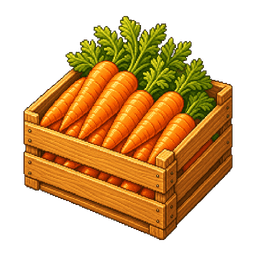
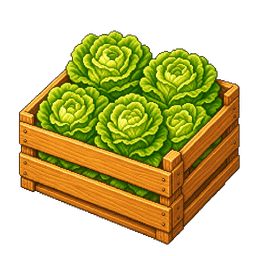
- The birth rate is 40% with wheat alone. Water adds 10 points; a crate of carrots and a crate of lettuces each add 25 points for the whole mini-hutch. These vegetables are for adults only.
- This rate applies to the number of pairs in the mini-hutch. Total births are rounded to the nearest whole number. With every food, each pair gives one bunny.
- Bunnies that become adults are placed before newborns. With no room in a mini-hutch of the right type, the extra adults or births are lost. A bunny that has just become an adult waits until the next day to breed, and an empty mini-hutch keeps the type it was built with.
- You can redistribute adults to form more pairs or use fewer mini-hutches. The farm automatically rebalances adults at the day change when the hutches allow it. Rabbits for sale stay in place; a dirty or sick mini-hutch must be treated before redistributing.
The Cooperative buys each adult buck or doe for 8 écus. Bunnies and adults can also be traded at the Market or on the Black Market.
Pastures
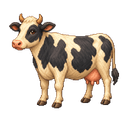
The cow becomes an adult from 10 days and 80 kg. At level 2, each milking gives 8 litres, to sell or turn into butter.

Milk and butter
- An adult, clean and healthy cow can be milked once before 6 p.m., then a second time from 6 p.m., Paris time.
- Milk can be sold in whole litres to the Cooperative for a litre.
- Making a pat of butter uses 12 litres and needs a free place in the shed. You can repeat it as long as there is enough milk and room.
Food and health
- Grass adds 5 kg a day. Straw adds 3 kg and water 1 kg. These extras come from the shed. The cow cannot exceed 750 kg.
- Soap cleans the cow and the syringe treats her. A dirty or sick cow cannot be milked.
- An illness left untreated for 4 days is fatal. The replacement cow starts growing from scratch. If she reaches 10 days and 80 kg at the day change, she can be milked right away.

Meadow
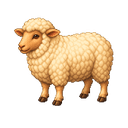
The sheep you get when moving up becomes an adult from 8 days and 30 kg. Its wool sells and counts towards moving up to level 3.
Growth and care
- The sheep grazes automatically and gains 2 kg a day. Straw adds 1.5 kg and a water bucket 0.5 kg.
- A crate of lettuces speeds up wool growth without adding weight.
- A soap cleans the sheep and a syringe treats it. It cannot exceed 110 kg and dies after 4 days of untreated illness.
Wool and revival
- A sheep that is already adult at the start of the day, and clean and healthy at the day change, grows 2 cm of wool, or 3 cm if it got a crate of lettuces. Wool is capped at 20 cm.
- The “Shear and sell” action sells all the wool at once, adds per centimetre and resets the length to zero. Wool takes no room in the shed.
- If the sheep dies, reviving it is free and optional. It comes back at 0 days, 4 kg, clean, healthy and without wool.